This is part two of my Isle of Lewis posts. I visited the island of Harris and Lewis recently with my wife ‘M’ and we had a lovely (if windswept) weekend exploring the many megalithic sites of west Lewis. Previously I posted about the main site Callanish I, and in this post I will explore Callanish II and III. “Callanish” is our anglicisation of the Gaelic (and preferred) “Calanais”. As I am inter-changeably sympathetic to both parties I will use whichever one I happen to type!
We started our Sunday on the Isle of Lewis by heading straight for Callanish III circle at Garynahine (thereafter shortened to “Gary”). It was the closest site to where we were staying, and is easily accessible from the main road, perched on a slight hill that became a promontory overlooking Loch Ceann Hulabhig.

The weather was so different to the day before. On Saturday it has been bitter cold but bright and sunny. Today was cloudy and cold, with a wind that brought drizzle like a fine mist. We were not going to get stunning vistas in our photographs today. I concentrated on the dowsing instead.
Callanish III (Cnoc Fhillibhir Bhig) is a beautiful circle to visit. Nothing about its positioning or proximity to the local populous would bring you to expect that from the road. A short walk up a slight incline, however, reveals something quite magical. Two concentric rings of tall stones made from the impressively pink Lewissian Gneiss that is unique to this landscape.

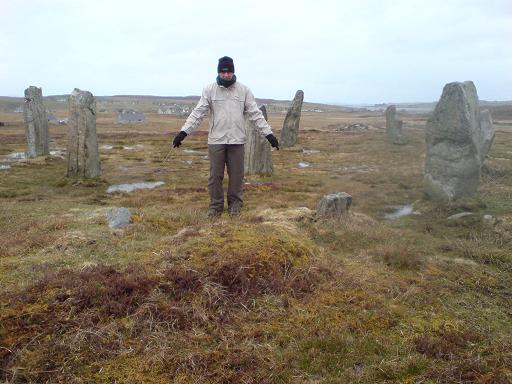
The outer ring still has eight of its original thirteen stones in place, although there are embedded stones or discoloured grass marking the other places (mostly). As I arrived I saw its inner four stones standing proud amidst a set of nearly-submerged faerie rings (small circles of different-coloured grass). I walked around the outside to get a feel for the site, and to locate an entrance. The bitter cold wind and drizzle meant that I was working expediently – only asking essential questions.
Where was the entrance? I found two embedded stones (both of which dowsed as containing female energy). The entrance was aligned NW/SE. The stone that I am pointing to on my left (your right) was identified as the Transformer Stone. Within a stone circle certain stones can be found to dowse positively for specific qualities. A transformer stone will be transform the radiant energies of either moonlight, sunlight or starlight – sometimes a combination of these. The energy then gets transmitted into the circle’s nemeton, or energy field. Soon I would discover just how this theory worked out, but that’s to come.

Were there any black streams? NO. Glad about that. It didn’t feel like there were. Any white streams? YES. So, there were some good energies at this site – a mixture of female and male energies combined forming ‘white stream’ energy. I had somehow returned to the entrance again, so I walked out of the circle and dowsed for the size of the circle’s nemeton – it’s area of influence, if you like, or the range of its energy field. It was about six feet out and dowsed for male, female and neutral energies. However, it was too cold to get into sorting that mixture out, so I pressed on.

I walked back into the circle to investigate the tall elegant inner four stones. One tall straight stone near the centre was the most powerful. Standing next to it I could feel an energy stream flowing out of its edged side. We see this a lot at sites – a stone that is almost triangular in shape, whose apex edge seems to focus energy along that edge of the stone. I dowsed for the qualities of the tall central stone and discovered that it could charge, discharge and control energies. Again, too cold to go into more detail. Next time I’ll come back in the height of summer!

Next – and with little hesitation – I turned my attention to the concept of finding any cross-over points or accumulations of energies. We call these ‘power centres’ because they always turn out to be the places we need to sit at in order to effectively work with the site’s energies. There was a male power centre in a clump of faerie rings inside the circle where there is a gap between some of the outer stones. The female transformer stone in the outer circle dowsed as being a female power centre.
I went around checking the qualities of each stone. Amongst all the stones there are three female stones amid predominantly male stones.

The last thing I wanted to know was how the site got its power – where were the sources of the male and female energies that combined so well to form a good white stream all around the site? I dowsed the male path and found that it circled the site twice (at least). Then it went into the transformer stone. Was this the origin? YES. I dowsed to see which radiant energy was producing the male energy. Surprise, surprise – it was sunlight.
I repeated the exercise for the female energy and was surprised that a female line squirmed out of the female transformer stone that formed part of the entrance, and headed off around the circle, then swerved out into the heathland on the south side. I tracked the line for five minutes as it marched me up hill and down dale. Finally it stopped at a two feet high stone, beautifully sculpted into a smooth mound, that was practically hidden in the heather about 50 feet away from the stone circle. This stone dowsed as drawing female earth energies out of the ground, and supplying them clockwise into the circle’s nemeton field.
All in all a well balanced and beautiful site on any day of the year. In the next Lewis post I will describe a very quick visit to Callenish II, and the Truiseil Stone – a quite spectacular standing stone hidden away in west Lewis.
Gwas.
Following windswept trails.