It was a bright and lovely Spring day that I found myself able to return from a training course via one of my favourite areas – the Vale of Pewsey, or the land of the White Chalk Horse. This is a wide valley (or vale) in Wiltshire that is renowned for having horse figures craved into its chalk hillsides, and is also the home to many of the most famous megalithic sites in England.
On this day I had dowsed for which of these wonderful sites I should visit – Avebury? West Kennet Long Barrow? Silbury Hill? None of these! In fact, the site that the dowsing rods said I should visit was East Kennet – a long barrow that I had tried to find twice previously, and now I was being asked to risk a glorious day on trying to find it again. I was wary, but if the rods said I could find it then I would try.
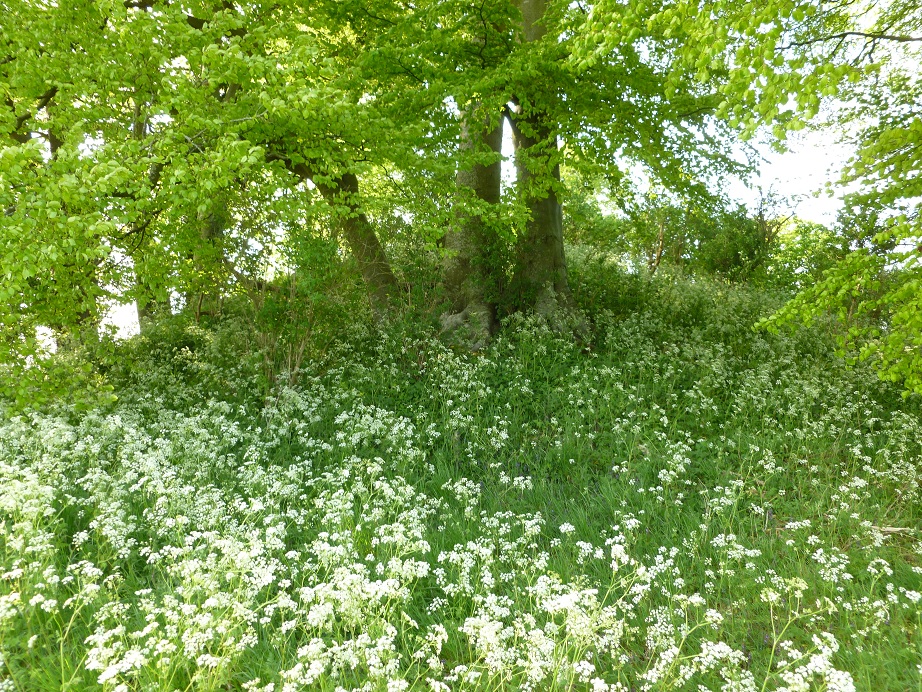
I parked next to the church in East Kennet village and then found the path leading through the farm and stables signposted for the White Horse Trail. I followed the bridleway up the hill and then walked along the adjoining fields, always making sure to keep to the unploughed or un-planted sides of the fields. This time, unlike previous efforts, I had a print-out of an OS map to guide me. I could see from the firm soil that many others had done the same over the years. Thankfully the barrow is still possible to recognise by its huge size. I guess that the clump of woods on the side of the roundest hill was a likely candidate for the barrow’s location. It had been especially helpful that I had seen the photographs of it in Peter Knight‘s book about the nearby cousin site of West Kennet Long Barrow. This was my third attempts t spot it and this time I had a more keen sense of where it should be in the landscape, and I was more in tune the rods, which could act as quick guides.
As I paced along the field boundaries I positioned the rods in front of me – “Please point to the barrow known now as East Kennet Long Barrow!” and soon the two rods were pointing in the same direction – up the hill and to the left of the next. After using the rods I put them away. Now I asked Nature herself if she would confirm the position of the barrow for me. A few seconds silence was pierced by a ptarmigan twenty feet to my right jumping into the air next to me and climbing low and slow over my head towards the clump of trees in the middle distance. I had my confirmation – the bird’s flight had confirmed what the rods said.

Now, as the clump of light green tree dominated by view ahead I could begin to establish the size of the mound – some 105m (348ft) long and 6m (19ft) high approximately. As it hove in to fill my view I began to feel for the path that I should take to approach the site. I felt that I needed to walk round to the “front”, which for some reason I felt was at the end that I hadn’t got to yet, so I walked slowly and reverently round to the front. As I neared the end of the copse of trees something reddish brown and larger than I expected was emerging and fleeing from the long grasses ahead and hopping and hiding in the cornfield next to me. I, and the rest of the animals in the vicinity, momentarily held our breath then exclaimed our surprise at the sudden movement that was rippling the air around us in a sonic boom of movement. Crows squawked, smaller birds jabbered, bunnies fled, and I said “Oh!”, or some words which intended to give a surprised sound. That was less reverential. More ‘residential’, language from the housing estates.
Clumsy fumbling for my camera was never going to capture the pace and grace of an already hidden deer. With my heart still racing I tried to calm myself down as I approached what I felt was an entrance., Certainly the local badgers like that area and have made many hands paths with which to approach the barrows highest and steepest end.

The east-facing edge was covered in Spring wildflower – Elder bushes in white bloom, dandelions, nettles and cowslips in abundance. All contributed their lilly-white lustre to the emerald green backdrop what covered the site like a well-fitting blanket. I stood at the edge of the tree line and felt for the boundary of the site. It was a few feet outside of the trees, and I stopped to ask for permission to enter from any site guardians. This was, after all, a new site for me so I was being careful, putting up protection from any negative influences at the same time as asking for permission to enter.
Permission was granted in the usual manner (see hundreds of previous posts to this effect) and I began to make my way up the slope using my intuition to guide me as to the best path to take. I passed several large beech trees on the way and stopped at each to commune and feel for the response. It was all positive – almost lonely! I got the feeling that the trees would like more visitors than they currently get, but as there is no public right of way this might be putting some people off. I say, go anyway. If you feel the urge you should claim your human inheritance and visit the barrow.
I reached the top of the mound without using my dowsing rods for guidance, and I already knew where my power centre would be – I had walked past it and it had caught my attention, pulling my energy body towards it. I took some pictures then went to stand in the power centre which was marked by a slight bare patch where no plants were growing. I got my rods out to confirm or deny the hunch – confirmed – I was standing right on the best spot for me to me. And what was the best place to communicate with any nature spirits at this site? Right where I was standing. Again the rods confirmed my intuition. Getting better at this!

The answer, my friend, is blowing in the wind
After some minutes of settling into the sights and sounds of the barrow I began my trance work, seeking to connect to whatever nature spirits may be resident at this place and who might wish to communicate with me. Soon I had a connection with a spirit that revealed its name to me. This was really positive, so I continued, using the wind as an indicator of answers to questions I was posing. If the wind blow then the answer was positive, and it it quelled then the answer was negative. A crude indicator, but no more or less so that dowsing, and much more “natural” for the spirit to communicate this way.
I asked questions about my latest Beltane quest – “See with the vision of the hawk“. The information that came back to me was that I was right to think that it involved a pilgrimage, and that there really was a landscape figure in the Cheshire countryside in the shape of a hawk. I also determined that the vision would be required to identify the hawk, but then there was more to do once I had found it. All useful information, for which I thanked the spirits and the winds for their assistance. Now I understood a bit more and could make progress.
I came out of trance and looked around – something was about to happen…..my phone rang. It was M. The number of times she does this is incredible. She always manages to ring just as I’m finishing a meditation!
I said my farewells to the site and began to pick my way through the badger sets at the base of the mound. From the barrow itself there are some interesting views of the nearby sites. West Kennet is visible and next to it Silbury Hill. You will notice in the photograph below (and it’s even more obvious from the barrow itself) that Silbury Hill is perfectly aligned with the horizon. From the barrow it is the top of the hill. From the foot of the barrow it is the terraced level just below the mound’s summit. Amazing alignments to see.

I was happy to have finally found the mound that I thought I would never locate. I had been fortunate enough to have had the time to listen to the winds, and speak with a spirit of Nature on the barrow. Maybe one day someone will re-open this site to the visitors it deserves. Until then, only those who want to find it will, eventually.
Gwas.