In this article I discuss the history of druid triads: their origins, structure and purpose. I discuss the greatest of bardic poets, Taliesin, and then mention some of the philosophical and mystical aspects of triads in general. This article was written with the help of AI. Initially I constructed it for my own edification, but on review I thought it was worth posting publicly as there is some useful information here.
The Roots of Oral Tradition
In ancient Celtic society, the Druids functioned as the intellectual, spiritual, and legal elite. Because they deliberately avoided writing down sacred or historical knowledge, poetry served as their primary vehicle for preservation. of this cultural heritage.
Druids committed thousands of lines of verse to memory through rigorous, decades-long oral training, usually a period of up to 19 or 20 years. These verses encoded tribal history, legal precedents, genealogies, and cosmological lore, ensuring absolute cultural continuity across generations without relying on manuscripts.
Transition to the Bardic Schools
With the arrival of Christianity in the 5th century, the formal structure of the ancient priesthood shifted. The learned poetic class – known in early Ireland as the filid and later closely aligned with bards – inherited the sacred and historical duties of the Druids.
Aspiring poets entered highly structured bardic schools, spending upwards of a decade mastering complex meters, grammar, and hundreds of traditional tales. This highly institutionalised system created a remarkably stable linguistic and literary tradition that preserved Old and Middle Irish forms virtually unchanged for centuries.
The Power of Praise and Satire
In Gaelic society, master poets (ollamhnai) occupied a position of immense prestige and political influence, holding social ranks nearly equal to royalty. Their verse functioned simultaneously as high art and political leverage.
Praise Poetry
Poets composed elaborate odes celebrating the generosity, leadership, and heroic lineage of their patrons.
An example of early Celtic/bardic praise poetry is an excerpt from The Lament for Owain (attributed to the master-bard Taliesin), which honors a Celtic patron and warrior for his courage and raids:
“He fed the black ravens of the air…
He piled up the slain like a wall…
Owain of Rheged, the generous hand,
There was none like him in the northern land.”
Satire (Áer)
A wronged poet could wield sharp, ritual satire to publicly shame a stingy or unjust ruler, a power deeply feared in a culture governed by honour and public reputation.

The most famous example comes from the mythological cycle The Second Battle of Moytura. The king of the Tuatha Dé Danann, Bres, treated the poet Cairbre mac Etain with terrible hospitality. Instead of a kingly feast, Cairbre was given a dark, cramped room without a fire, and only three small, dry biscuits to eat.
In revenge, Cairbre composed the first áer in Ireland’s history. His short, biting verse stripped the king of his honour and ultimately cost him his crown:-
“Without food quickly on a dish,
Without milk for a calf to grow on,
Without a man’s lodging for the night,
Without enough money to pay the bards –
May that be all that remains of Bres!”
Following this poem, Bres’s reputation was shattered, his face broke out in red blemishes, and he was forced to step down as king.
Legacy and Modern Revival
Though the formal medieval bardic system largely collapsed by the 17th century, the heartbeat of druidic verse survived through folklore, regional music, and later Celtic literary revivals. Today, modern Druidry maintains a foundational “Bardic grade,” encouraging students to engage with nature, ritual, and storytelling through creative writing.
The Two Faces of Taliesin: History and Legend
Taliesin is arguably the most famous figure in early Welsh literary tradition, occupying a unique space between a real historical person and a mythic shape-shifter. His name has become synonymous with the soul of Celtic poetry and bardic inspiration.
The Historical Poet of the 6th Century
In historical reality, Taliesin was a sixth-century Brittonic bard who sang at the courts of various northern British kingdoms during an era of intense conflict with the Anglo-Saxons (Hen Oledd, or the Old North, covering parts of northern England and southern Scotland). His reputation however, has mythologised him as the primal bardic figure.
Court Patronage
He composed fierce, highly crafted praise poetry and elegies for powerful rulers, most notably Urien Rheged and Urien’s son, Owain.
The Book of Taliesin (Llyfr Taliesin)
Though compiled centuries later in the 14th century, this famous Middle Welsh manuscript preserves poems attributed to him, offering a rare window into early heroic Celtic warfare, loyalty, and court culture.
The Mythological Origin: Gwion Bach and Ceridwen
Over the centuries, the historical poet was mythologised into a semi-divine wizard and prophet, detailed in medieval folklore such as the Hanes Taliesin. The Hanes Taliesin is a 16th Century Welsh recounting of the mythological origins and magical life of the renowned bard Taliesin. Here is a short version of his transformation from humble servant to supreme bard.
The Magic Cauldron: Awakening and Shape-Shifting
The sorceress Ceridwen brewed a magical potion of Awen (divine poetic inspiration) and supreme knowledge in a cauldron, meant to steep for a year and a day.
Her young servant, Gwion Bach, was left tending the fire and accidentally splashed three drops from the hot brew onto his thumb. Sucking his thumb to ease the pain, he instantly absorbed all the wisdom of the cosmos.
Fearing Ceridwen’s fury, Gwion fled. A legendary chase ensued where both shape-shifted through various forms – a hare and a greyhound, an otter and a fish, a bird and a hawk – until Ceridwen, as a hen, swallowed Gwion, who had transformed into a grain of wheat. She later gave birth to him as a remarkably gifted infant, setting him adrift in a coracle where he was found by a prince named Elffin.

Elffin removed the child from the coracle (possibly the beginnings of the practise of wrapping a druid in a leather hide or bag to aid prophecy and inspiration) and seeing his brow radiating with inspiration named him Taliesin – “radiant brow”.
Shamanic Echoes and Modern Resonance
In several esoteric poems found within The Book of Taliesin, the speaker’s voice transcends a single lifetime, famously declaring a deep, cosmic connection to nature:-
“I have been a multitude of shapes, before I assumed a consistent form. I have been a sword… a tear in the air… a word among letters.”
This mystical perspective mirrors ancient shamanic concepts and druidic ideas of soul continuity. Today, modern Druidry and Welsh cultural institutions (such as the prestigious chairing of the bard at the National Eisteddfod) still look to Taliesin as the ultimate archetype of the inspired artist.
The Architecture of Wisdom: Structure, Grammar, and Symbolism in Druidic Triad Poetry
Ancient Celtic tradition preserved its deepest philosophical, legal, and spiritual lore not through dense treatises, but through a unique mnemonic art form: the triad (teroed in Welsh). These three-part aphorisms served as the textbooks of the bardic and druidic orders, encapsulating complex conceptual frameworks into elegant, memorable verses.
1. Structural Architecture: The Power of Three
At its core, the structure of druidic triad poetry is built on the psychological and philosophical resonance of the number three.
- The Setup and Resolution: A typical triad introduces three parallel elements or examples that share a common thematic category, concluding with an underlying unifying principle or outcome.
- The Mnemonic Anchor: In an oral culture preceding widespread literacy, structure was survival. The triad acted as a mental filing system. Bardic trainees could easily recall complex laws, genealogies, or cosmological truths by remembering numerical anchors (“Three things that diminish wisdom…”).
- Comparative Balance: The structure frequently relies on either accumulation (three positive traits compounding) or contrast (two contrasting elements resolved or balanced by a third).
2. Grammatical and Rhetorical Style
The grammar and syntax of traditional Welsh triads (‘Trioedd Ynys Prydein’, or the ‘Triads of the Island of Britain’) are optimised for oral delivery, rhythm, and rhetorical impact.
- Parallels and Anaphora: Triads heavily utilise repetitive grammatical frames. Each line typically begins with the same introductory formula (e.g., Tri phrif gynghor / “Three chief counsels”), creating a cadence akin to a chant or incantation.
- Linguistic Economy: Verbs are sparse, and modifiers are chosen with extreme precision. The grammar avoids subordinate clauses, favouring parataxis – placing independent clauses side-by-side to create a rapid, accumulating rhythm.
- Alliteration and Consonance (Cynghanedd): While later medieval Welsh poetry formalised strict acoustic matching (cynghanedd), early triad forms utilised rhythmic assonance and alliteration to make the phrases roll off the tongue effortlessly.
3. Symbolism and Esoteric Meaning
The triad was more than a literary device; it was a map of the cosmos. The number three held immense sacred geography in Celtic cosmology.
- The Three Realms: Many triads implicitly reference the tripartite division of the cosmos: Abred (the world of journey, struggle, and rebirth), Gwynfyd (the white world of purity and light), and Ceugant (the infinite circle where only divine truth resides).
- Triskele Dynamics: Symbolically, triads reflect the dynamic equilibrium of the triskele – forces moving in opposition or progression that ultimately resolve into a unified whole. They reject rigid dualisms (good versus evil) in favor of a triadic worldview where balance is achieved through a mediating third force.
- Veiled Knowledge: The surface meaning of a triad is often deceptively simple, masking deeper layers of legal precedent, seasonal observation, or metaphysical insight meant to be unpacked slowly through druidic tutelage.
Triads of poetry
Druid triads are a traditional mnemonic format consisting of groups of three objects, principles, or historical figures that share a common link. Historically, this triadic structure was utilised by Celtic bards and Druids in the UK to pass down complex laws, ethics, and mythology through oral tradition.

The Battle of the Trees (Cad Goddeu)
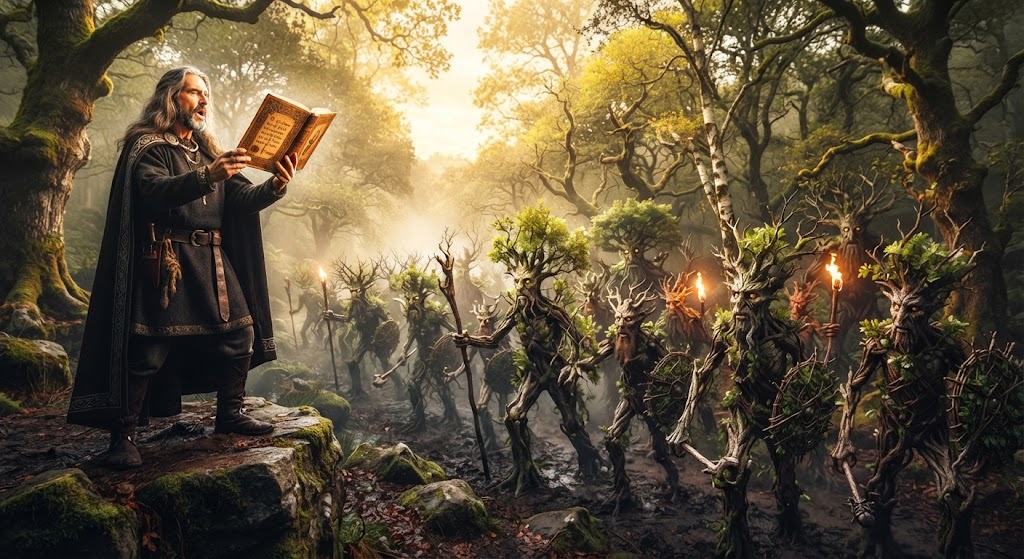
Cad Goddeu (Middle Welsh: Kat Godeu, English: “The Battle of the Trees”) is a medieval Welsh poem preserved in the 14th-century manuscript known as the Book of Taliesin. The poem refers to a traditional story in which the legendary enchanter Gwydion animates the trees of the forest to fight as his army.
“I was at Caer Vevenir when the winds rushed to gather a tumult of grass and trees, the clamour of bards as one.
On it swept, and the baying, wondering disbelief of the warriors mingled heavily into the exaltation of the Brython at all that Gwydyon had drawn forth.
Drawn forth by calling on the Creator, onto all the Eternal, calling that deliverance be brought that day.
Language poured forth the myriad forms of the elements, formed of wisps of words.
They curled and swayed, stretched and solidified into the forms of trees in the blasting noise of battle.“
The Stanzas of the Graves (Englynion y Beddau)
While compiled in later medieval manuscripts like the Black Book of Carmarthen, these stanzas stem from a much older, oral Brythonic heroic poetry tradition. They utilise a distinct poetic structure known as the Englyn Milwr (The Soldier’s Stanza), which is inherently triadic: it consists of a three-line stanza sharing a single, continuous end-rhyme. Here is an example:-
“The grave of March, the grave of Gwythur,
The grave of Gwgawn of the Red Sword;
An enigma to the world is the grave of Arthur.”
Triads of mythology, philosophy and wisdom
The most famous collection containing these elements is the Trioedd Ynys Prydein (The Triads of the Island of Britain). Additionally, 18th-century “revivalist” collections—most notably those by antiquarian Iolo Morganwg—fundamentally shaped modern Druid philosophy.
Below are examples of the most famous historical, mythological, and philosophical Druid triads in these islands. They may be considered as poetic in themselves.
1. Mythological & Magical Triads
These traditional triads catalogue the ancient magic, lore, and schools of enchantment found in early British and Welsh mythology.
- The Three Great Enchantments of the Island of Britain:
- The Enchantment of Math, son of Mathonwy (which he taught to Gwydion)
- The Enchantment of Uther Pendragon (which he taught to Menw)
- The Enchantment of Rudlwm the Dwarf (which he taught to Coll)
- The Three Naturalists (or Learned Men) of Britain:
- Gwalchmei, son of Gwyar
- Llachau, son of Arthur
- Rhiwallawn Broom-Hair
- The Three Mighty Achievements of the Island of Britain:
- Raising the stone of Ceti
- Erecting Stonehenge
- Heaping the pile of Cyvrangon
2. General Wisdom & Behavioural Triads
These rhetorical triads were used to teach everyday caution, psychology, and observation.
- Three Things Not Easy to Restrain (or Check):
- The flow of a torrent (a cataract in full spate)
- The flight of an arrow from a bow
- The tongue of a fool (or a rash tongue)
- Three Keys That Unlock Thoughts:
- Drunkenness
- Trustfulness
- Love
- Three False Sisters:
- “Perhaps”
- “Maybe”
- “I dare say”
3. Philosophical & Theological Triads
In his famous 19th-century collection Barddas, the controversial Iolo Morganwg outlined the core spiritual doctrine of the British Druid Revival, detailing the three concentric circles of existence:
- The Three Circles of Existence:
- Annwn: The abyss or underworld (the lowest state of being where life originates)
- Abred: The stage of human struggle and transmigration (the material world where we learn from suffering)
- Gwynfyd: The circle of white light or purity (the heavenly state of ultimate fulfillment and peace)
- The Three Objectives of Druidry:
- To reform morals
- To secure peace
- To celebrate everything that is good and beautiful
4. Modern Neo-Druid Triads
Modern practitioners in the UK continue to compose and live by triads to frame their spiritual practice. A prominent contemporary example used by modern Druids to guide daily life includes:-
- The Triad of Sacred Living:
- Hearth as Altar
- Work as Worship
- Service as Sacrament
Legacy
Ultimately, druidic triads represent a brilliant marriage of form and function. By wedding tight rhythmic grammar with profound threefold symbolism, the ancient bards created a resilient vessel of cultural memory that survived across centuries of transition.