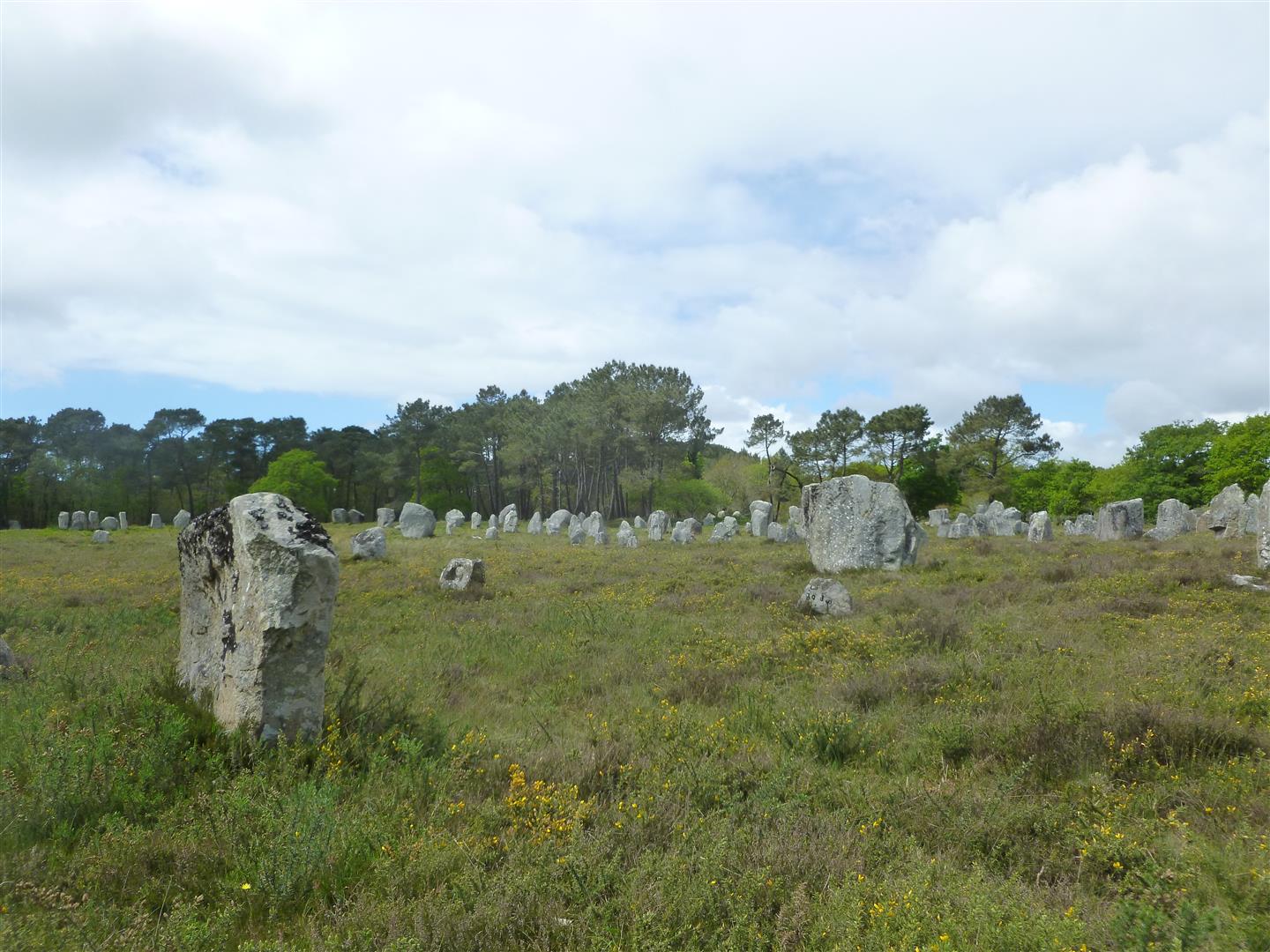
This is the final part of the blog posts about the three main Carnac sites I visited in May of 2009. I didn’t feel inclined to dowse inside the fenced off field of stones, as I had already gathered the information I needed from the other fields, so M and I concentrated on visiting the satellite sites around the field of alignments.
Kerlescan
We drove to the last field of stone alignments. It had been a long walk already in the strong Breton sunshine and we didn’t want to end the day completely exhausted before driving back to the northern coast again. We drove past the Ménec stones again, the two pairs of entrance stones, the Kermario stones and tower, and now we were into new territory as the road wound through the beautiful woods that line the road. It reminded us of Delamere Forest close to home, but with megalithic surprises and stunning vistas of flowing stone rows round every corner.

We parked in a little car park that held only eight cars and bagged the last space. Seems as though this section was quite popular with dog walkers. Certainly there were plenty of hounds bounding around as we began the walk past a horse stable and down the only path through the woods, following the occasional wooden sign pointing to The Quadrangle and Giant’s Stone. Sounded exciting, and for once I hadn’t done my homework in terms of knowing what was coming up, or where to find it, “C’est loin au Géant?” I asked a group of people coming in the other direction after ten minutes walk down the path. “Oui – c’est sept kilometres!” one of them joked with a grin before telling us that it was really only a short distance further to the two sites. Good job it wasn’t far – we were tiring quickly after spending the whole day walking and dowsing.
Manio III
We emerged into a clearing with a quadrangle made of thin slabs of stone. Within sight of that was a huge menhir, nineteen feet tall. This looked interesting. First thing’s first – the quadrangle.

A long rectangle of upright slabs of stone that enclosed a space that must have been a special space. The slabs were between a foot and three feet tall. A habitation perhaps? A religious building? A sacred space, I wondered? I dowsed for the location of a power centre of energy. Nothing. OK, what about a female line? Nothing. A male line? Nothing. Any energy at all here? Nothing. It was barren! Completely empty of any energy. OK, maybe something had happened to clear it. I later read in the book “Standing Stones: Stonehenge, Carnac and the World of Megaliths” published by Thames & Hudson that the site had once been covered by a mound of earth – a tumulus. The book stated that the quadrangle had been the site of many burials. Did it have any energy in it? NO. Nothing at all, I re-queried? NO. Time to move on.
Giant’s Stone
There was a stunning view of the megalith called The Giant’s Stone from the Quadrangle. An overgrown path through the trees framed it perfectly, and it was too tempting. I hurried on towards it eager to see whether this stone was still energised or not. I wasn’t alone. The stone seemed to be drawing people to it, yet no-one was lingering at the quadrangle for long. A boy was walking along the tops of the slabs, but quickly got bored with that and headed for the Giant’s Stone. It seemed to draw people towards it.

I approached the Giant with my copper rods and began asking questions in the midst of the constant stream of visiting groups. I stood alongside it and decided to dowse outwards from the stone for the nemeton, instead of my usual approach method. Why hadn’t I thought of doing it this way before? It was such an obvious way to do it. The rods showed a barrier response some thirty-odd feet away. Quite impressive! It was consistent on both sides in terns of its size.

The stone itself tested for having inherent female energy. It was drawing up energy from the earth – female energy. In addition it was drawing down female moon energy. I was intrigued by the stone and how much people who were visiting it wanted to touch it and stay around it for ages. I waited for my next opportunity in between the people posing by the Giant. I wondered if there was any energetic formation in evidence here. Did the stone make any particular pattern with these female earth and moon energies? The rods crossed in confirmation that there was something there. Off I went, starting from a small indentation on the stone’s western edge. A line moved around in an arc. Several minutes later I had found a most fascinating shape – it was a labyrinthine pattern similar to the labyrinth that I had identified as the spirit of the Callenish complex. I was both amazed and delighted at the pattern – a beautiful flowing path that ended in a small terminus spiral near the centre.

Kercado Tumulus
We returned to the car and then continued down the road past the Kerlescan field of stone alignments. No stopping this time, but just viewing their incredible expanse. I spotted another site to visit on the map : Kercado Tumulus. Sounded interesting, so off we went, turning down the entrance way to what appeared to be a stately home of some kind. In the car park for the site we saw a sign advertising the Indian Restaurant located somewhere within the confines of the manor house. What an unusual place to have an Indian Restaurant! It was like finding a Pizza Hut on top of the Cliffs of Dover.

Well, can I add anything to that? Only that M bumped her head going into the entrance and had to retire yelping to the standing stone that was twenty feet in front of the opening, where she curled up in pain! I came back out to comfort her, but there’s nothing you can do apart from check there are no fractures….not conducive to continuing dowsing, so I hurried off a few pictures and we left shortly afterwards.

If you visit Kercado please make sure you keep low down for several feet when you enter. It’s solid rock and not very forgiving!

All around the site on the shaded side are small standing stones that must have once ringed the tumulus. I had not yet experienced a tumulus that had been preserved close to what I can merely guess may be its original format. Other tumuli seem to have mainly lost their encasing circles and now stand alone. Perhaps I just haven’t seen enough of them, but Kercado was nice to visit – a pleasant site in a lovely setting.

Conclusion
This had been a long day, but so worthwhile. There had been so many correlations between this set of expansive sites and other sites I have dowsed previously. If you have any interest at all in the natural wonders that we have been left with by our ancestors, then Carnac is one of those places that inspire a wonder that refreshes the soul. For me, it gave me a jolt of inspiration and motivation to continue working harder to uncover the way in which these energy centres could be used today. So many sites have been lost to use through wanton destruction, ignorance and neglect that we should visit what we have left while we still have them.
I have been stunned by the number of people visiting ancient sites whilst Kal and I have been working there – some are almost continuously visited in all weathers. That much is heartening – but surely the time must come when we need to evaluate their significance as they are so much more than simply curiosities. I think people feel that at a deep and almost subconscious level. We need to bring that feeling out into a more conscious light by showing how they can be used to benefit the lands in which they stand.
Gwas Myrddyn.


