When I began this blog it was simply to record my experiments with dowsing, and a growing relationship with a spiritual connection to Nature. Very quickly that escalated beyond any confines that Kal and I had placed upon ourselves. The blog began to shape itself to align with how we followed energetic high points which aligned to the sacred calendar that modern druids now frequently use.
Kal always called himself an “Edge Wizard”, which was an amusing play on my insistence on calling myself a “Hedge Druid”. Many times we discussed and played with the concepts of what those monikers meant both to us and to those we encountered, whether physical or spiritual beings. In this blog post I discuss what a hedge druid traditionally is, and whether some of the outlying aspects of an engagement with certain spiritual entities and other people aligns with that concept.
Walking the Boundary: The Modern Hedge Druid
In the landscape of contemporary nature spirituality, modern Druidry offers a wide variety of paths. From large, structured international orders with elaborate grade systems to local, community-focused groves, there are many ways to engage with the tradition. Yet, for those who prefer an independent route, a distinct archetype has emerged: the hedge druid.

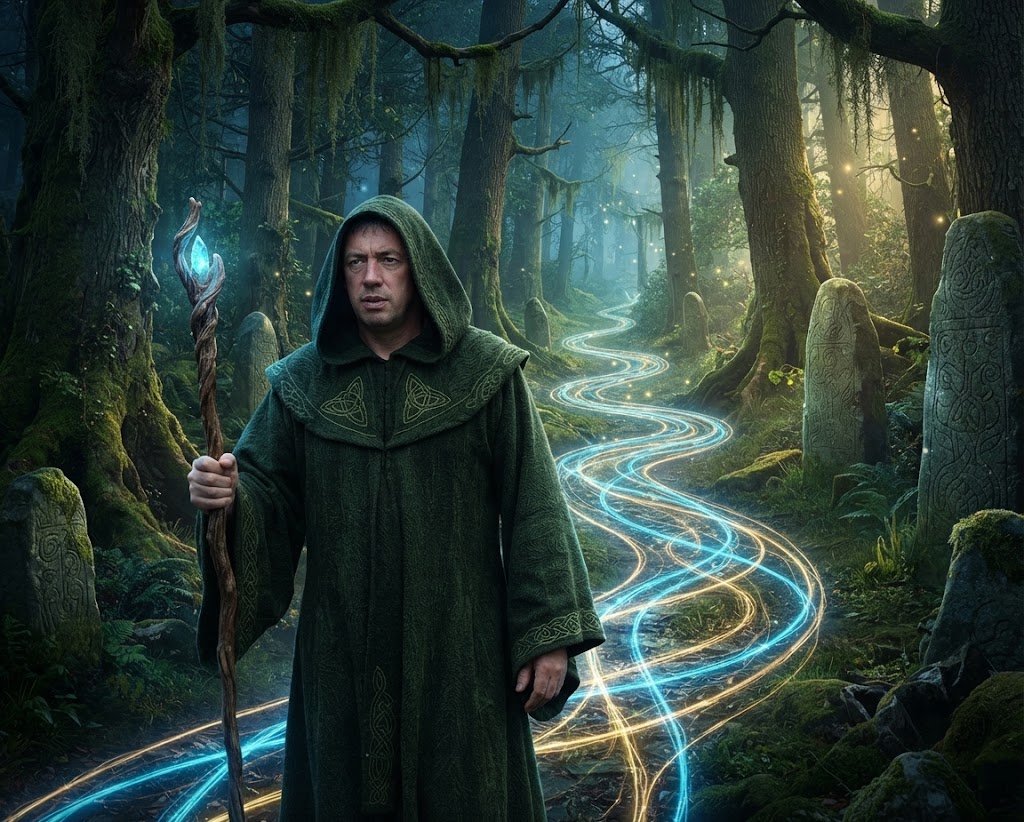
Operating very much as a spiritual DIY path, hedge druidry takes its name from the traditional “hedge-witch” or wise-woman – one who lives at the margins, bridging the domestic world of the village and the wild, untamed energy of the woods and fields. In other words, to a certain extent (and frequently guided by Nature’s forces) a hedge druid is capable of defining their own path at the liminal spaces which exist alongside and in between the more structured normatives of society and the magickal spaces which hedge druids use to interact with other entities (that have their own rules of engagement).
What a Hedge Druid Is (and Isn’t)
At its core, a hedge druid is a solitary, nature-centered practitioner. We focus heavily on animism, seasonal shifts, local ecology, and personal intuition. Rather than relying on a governing body, rigid dogmas, or a mandatory liturgical manual, we hedge druids craft a practice tailored directly to the land we inhabit. Our “temple” is the local park, a backyard garden, an ancient woodland, or a canal bank. We are not above reclaiming the use of ancient sacred sites such as stone circles, barrows, henges and hills, however. We do like to be seen connecting to our ancestry, even if that link is now tenuous for the modern druid thanks to so much broken lineage over thousands of years.
Hedge druids study native plants, honour the turning of the solar and lunar cycles, and cultivate a direct, unmediated relationship with the living earth and the beings which inhabit it. Usually, a hedge druid is drawn to Nature spirits, elementals and the Faery Folk for consultation and co-operation when working in harmony with Nature.
Crucially, hedge druids are not ancient Celtic historical reenactors. While modern Druidry draws inspiration from historical philosophy and Celtic mythology, the hedge druid does not claim an unbroken, ancient lineage stretching back to Iron Age priests.
Hedge druidry is neither a dogmatic nor passive form of spirituality. It requires active ecological engagement and personal accountability. Because there is no central hierarchy to validate the path, it demands self-discipline, curiosity, and a deep, respectful listening to nature rather than adherence to a strict set of rulebooks.
Bridging Traditions: Saints, Angels, and Ascended Masters
Is it therefore feasible, and justifiable, that a hedge druid could interact not only with so-called “natural” spirits, but with those spiritual forms which may be seen as adjunctive or not obviously directly related to the discipline? Because hedge druidry is inherently flexible and non-dogmatic, many practitioners blend their earth-based path with other streams of esoteric or religious wisdom, including Christian saints, angels, and ascended masters.

Historically, Celtic Christianity and older indigenous lore often intertwined, viewing holy wells, sacred trees, and spiritual guardians through multiple lenses. A hedge druid might seamlessly honour traditional land spirits while simultaneously working with figures like Saint Francis (the patron of ecology and animals), archangels associated with the four cardinal directions, or ascended masters focused on compassion and healing. In the garden of the hedge druid, the sacred is expansive; any figure that embodies deep wisdom, healing light, or a profound connection to the divine spark of creation can find a welcome place at the altar.
When is a hedge not a hedge?
In 2026 I answered a call from a local druid to join a new group. More recently I have accepted invitations to work in a grove which is very much aligned to the Order of Bards, Ovates & Druids (OBOD). These recent changes have meant that I am now working with others, and especially in areas of work that I would previously have shunned, such as organised ritual. Can I still call myself a hedge druid in these circumstances? I think so. Although I do meet other kindred souls occasionally, and enjoy sharing both my experiences with them, and to learn from theirs, I very much still work alone on my own spiritual path and progression. As was the case when Kal was still alive, I occasionally venture out with other spiritual people (of whatever calling they have) to work. I don’t think that much has changed since the very start of this blog. I am, and still identify myself as, a hedge druid.
With all that said, I hope that has helped to answer any questions you may have harboured about the definition and soul of what a hedge druid is, and more specifically, about how I view such a concept. My aim now is purely to live up to that definition, today and always.