The White Line
Length: 331 miles.
In my previous post about this triangle, called The Lunation Triangle by its discoverer Robin Heath, I talked about The Rose Line. The Rose Line goes from Edinburgh to Cardiff and passes through several sites of stronghold along its route, and many places associated with red or rose colours.
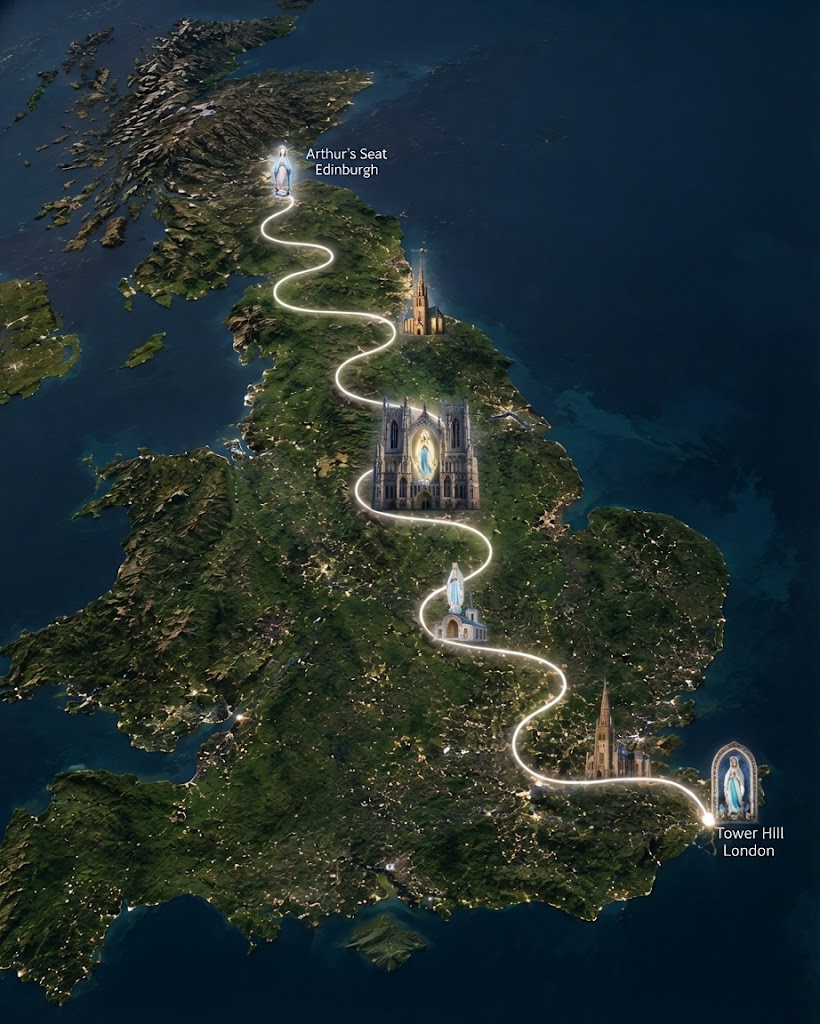
In this post I am talking about another axis on that landscape shape – what I am calling The White Line. The line tracks a route between the old power centres of “The White Hill” (now more commonly called “The Tower of London”) in London‘s centre up to the ancient symbol and site of power “Arthur’s Seat“, a hill in the central area of Edinburgh.
The White Hill (or White Tower) is associated with Bran the Blessed and King Arthur. You can read about that association here.
Along the route are many associations with The Virgin Mary. For example:-
- churches dedicated to St Mary in cities, towns or villages close to the line
- schools associated with or founded by a church of St Mary
- lots of places which are creches, playgrounds or schools for young children – an association with innocence
- bodies of water (lakes reservoirs and many rivers and streams or “becks”) – associated with attracting the female energy lines
- places (especially towards the northern end of the line) which include derivatives of the term “white“

The list of associated “white” places includes:-
- Whitehill
- Whitglen Canine Conditioning Centre
- Whiteside Farm
- Whitchester Farm
- Whiteley Shield Bastle
- Whitehall
- West Witton (near Leyburn) – the site of a Templar Chapel, and at harvest festival they perform the “Burning of Bartle” here
- Whitbeck Farm
On the White Line the association with the colour white, although a strong folk memory in Yorkshire and further north, disappears and is replaced by churches dedicated to St Mary. This coincides with the line passing through more populated villages and towns as it reaches the industrial heartlands of South Yorkshire and beyond.
A characteristic of the spread of these churches, and one which is often found when tracing female energy lines across a ley line, is that the churches of often in villages which are up to a mile away from the line. If their position is traced along the line a kind of weaving, flowing pattern emerges. Much like when a dowser follows a female line across the land. The path will be a weaving, flowing line which sinews from side to side. So it is with this female-associated line too.

In addition, like many “traditional” ley lines the White Line passes through or close to many places whose names end in the suffix “ley”, such as:-
- Oakley
- Weekley
- Great Oakley
- Mapperley
- Pleaseley
- Tinsley
- Thorpe Hesley
- Harley
- Barnsley
- Woolley Grange
- Howley Hall
- Morley
- Pudsey Stanningley
- Calverley
- Guiseley
- Burley in Wharfedale
- Braidley
- Hadley
So far we have the rose (red) and white lines. See Alison Leigh Lilley‘s excellent post about the associations and folklore of these colours (blog post). That post talks about three traditional colours, and so far we have looked at the Red and White lines. So, will the next line, which is connected to Bran’s White Hill, have any associations with crows, raven or the colour black? We will see soon in my next post about that final part of the Lunation Triangle.