Tuesday 5th May – The St.Uzek stone and the Isle Grande ‘allé couverte’
Being up at the crack of dawn to disembark the ferry at St.Malo, then driving an hour in unfamiliar territory, and on the opposite side of the road to reach your holiday base, then unpacking and heading straight out to the Pink Granite Coast in north-western Brittany – a mere two hours away – is all in a day’s work for an intrepid ley-hunter and day-to-day dowser. That kind of enthusiasm is only to be expected when the quarry being chased is so tempting!
On the agenda shortly is Mont St.Michel, but on this first day I headed to the highest point along the stunning Pink Granite coastline in my trusty french steed, with my redoubtable wife. The rewards were indeed worth the hunt. On this first day I got to find a huge menhir called St.Uzec (or St.Duzec) and an “alle couverte”,or “covered alley” – a long passage grave or dolmen, in effect. Details about that later. First – the St.Uzec menhir.

The menhir is to be found in the village of Penvern (which sounds more Cornish than Breton). It is almost signposted and a little faith will get you there. It seems very well visited, but no-one lingers for more than a minute or two. And I found out why! As M and I walked up to it from the little car parking bay, admiring its immense height and red granite composition, there was a moment when things went still and quiet. M decided she didn’t want to go near it and veered off up the small road going uphill to follow a trail leading to the chapel nearby. I walked into the fifteen feet long walled enclosure and dropped my bag off at the base of the menhir, next to what looked like a tiny font placed at its base.
There were some symbols carved into the stone’s upper area – a sun, a geometrical figure, other obscure images, Atop the stone was a cross made from a different stone, and a different time. It was a Christian addition, probably added when the stone was given the saint’s name that it bears now. From earlier drawings and pictures I have seen of this stone it was once adorned by a carving of Jesus hanging from a cross.
I stepped back out of the enclosure with my dowsing rods, walking to the far side of the approach road. I had had experience of the size of the nemeton field for stones of this size before so I was giving it a good run-up! I dowsed for the edge of the stone’s field of influence. I walked forward. And kept walking. When I got four inches away from the stone the rods parted in a barrier reading. Four inches away! What?! I was stunned. On Lewis I had dowsed the Truiseil Stone which had a nemeton of some thirty feet. Now four inches for a stone that was just as tall if not taller, and twice as wide.
I asked the rods some questions.
- Was the nemeton being restricted unnaturally in some way? YES.
- Was it a result of human intervention? YES.
- Were the symbols on the rock related to this in some way? YES.
- Was it the placement of the cross on top that was restricting the stone’s energy field? YES.
- Was there something I could do to repair this energy field? SORT OF. Could I do it permanently? NO. Would it be something temporary then? YES.
- Did I have the means to do this work? YES. But I didn’t have the strength.
My rods hung loosely and I started to look around aimlessly. I took a few more photographs then wandered away and met M as she came towards the stone from her travels around the historic route she was taken earlier.
As we walked away from the stone, me explaining that there was something awry with the energy field, I realised that a strong tightness in my temples was lifting. I kept walking away from the stone and it went completely as I got more than fifty feet away from the monstrous megalith. There was something seriously wrong with the energies around that stone – no wonder no-one stayed close to it for very long! You may have noticed from the picture that a cross has been placed on top of the giant menhir. It caught my eye too. Back to the rods one last time: Was the reason that this menhir did not have a proper nemeton directly related to the placement of the cross on top of it? YES. This stone had been “capped” by the placement of this cross. Was it simply the cross shape, I wondered? NO, said the rods. Was it the intentions of the people who put the cross there that inhibited the energy? YES. Time to move on.
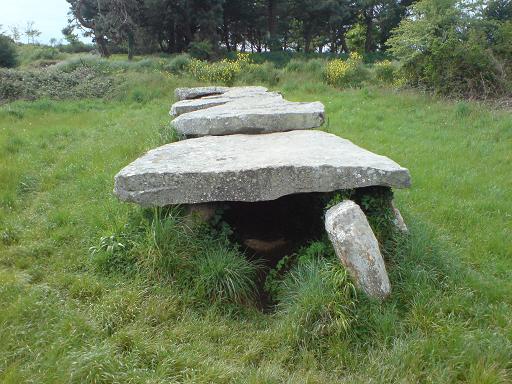
We decided to go to another nearby site on the Isle Grande which was only a few miles the other side of the village. Well, after a bit of to-ing and fro-ing we found it, no thanks to the signage! The allé couverte that I was searching for was on Isle Grande. This is also the name that Aubrey Burl gives to the site as well as its location. It was thanks to Burl’s description in his ‘Megalithic Brittany‘ guide that I was able to find it at all. The French, it seems, are only vaguely interested in denoting the presence of their megalithic treasures, much as we English have also mainly achieved. The site was marked by a small knee-level sign that was side-on to the road making it invisible to passing traffic!

The avenue of stones was constructed of flat but wide slabs, with the square entrance way being wide and tall enough to stoop within. There were seven large capstones supported on standing flat stones. There were two chambers, the first being the longer of the passageways utilising five of the capstones in length, whilst the remaining two capstones comprised a second smaller chamber large enough for maybe two men kneeling or tucked in tightly.
As I dowsed the site I found no female energies there at all, which was very surprising, as I can’t remember the last site that I dowsed that didn’t have at least some female earth or moon energies present. This site was simple inhabited by two energetic sources – a male line with two power centres at either end, and a neutral power centre that looped back upon itself. Finding a neutral power centre was another rarity. Already I was sensing that dowsing in France was going to be an interesting endeavour, and one where I would need to try to be as objective and comprehensive as possible. Unfortunately, on this occasion, time was pressing for us to organise some food for the self-catering aspect of our holiday, and so I didn’t ask all the things I could have.
I did find out that a neutral power centre located at the end of the first longer chamber encompassed the inside and outside left-hand (southern) edge. The right-hand edge of the passageway is fed by a male power centre on the right-hand end of the inner passage, directly opposite the neutral centre. There was another male spiral at the centre of the smaller passage. This came out of a hole between two capstones to join with the male energy travelling along the first chamber.
 I did some dowsing as to the purpose of the site and eventually narrowed the concept down to it being a place of transformation and initiation. How that was done exactly I don’t know. Perhaps it’s something you have to try for yourself one moonlit summer’s night?
What a great start to the holiday. Two sites visited on the first day of landing. I honestly didn’t expect that, and was amazed at how many sites there were in the environs around St.Brieuc. Perhaps I would run into some others as we travelled around in the next ten days? Indeed we did.
Gwas
Following the pink coastline (this is not a euphemism)


